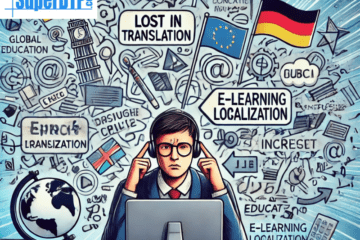
E-learning Localization
Teams may easily study at any time and from any location with e-learning, which is digital training given online. It facilitates large-scale information sharing, maintains content consistency, and engages students in their native tongue.
What is e-Learning Localization?
E-learning localization is the process of modifying digital training materials, including courses, modules, and videos, to include interactive elements for consumers in many linguistic and cultural contexts. This includes:
- translating narrative scripts, on-screen text, and UI components
- Localising multimedia (e.g., voiceovers, graphics, and subtitles)
- Idioms, instances, illustrations, and units of measurement are examples of cultural adaptation.
- Compliance with laws and regulations in accordance with local training requirements
Language Service Providers (LSPs) with expertise in this process assist firms in making sure that their training programs are successful, culturally appropriate, and available globally.
Key e-Learning Assets to Localise
The following resources should be localized in order to provide a uniform educational experience across regions:
- Core course content (Text, quizzes, assessments, and instructions)
- Multimedia (Audio narration, video content, motion graphics)
- Navigation/UI elements (buttons, menus, progress indicators)
- Home pages, landing pages, help sections, and contact pages are examples of supporting pages.
By reviewing these documents and advising customers on which assets are most important to localize first, LSPs can provide value.
Best eLearning Platforms for Localisation
Delivering flawless localization services requires an understanding of the technologies your clients employ.
We’ve had the honor of working on e-learning projects in a variety of industries and with some of the top e-learning platforms worldwide. Understanding how to effectively manage the distinct capabilities that each platform offers to the localization process is crucial.
The e-learning platforms listed below are popular for corporate training and provide robust support for multilingual content:
- Articulate Storyline
A popular authoring tool for complicated, scenario-based learning that is extremely interactive. Storyline facilitates localization of multimedia, navigation, and tests, as well as simple text export/import for translation. - Articulate Rise
A browser-based program perfect for creating modular, mobile-responsive courses. Rise works well with LSP workflows and makes it simple to duplicate material for many languages. - Adobe Captivate
Captivate, which is well-known for its strength and adaptability, can handle branching situations, screen recording, and audio dubbing. It enables fine-grained localization of embedded multimedia and user interface components.
These platforms are perfect for LSPs offering localization and desktop publishing services since they provide export options, XML/Excel-based translation workflows, support for DTP engineering, and special capabilities catered to the creation and delivery of eLearning content.
The e-Learning Localisation Workflow

A thorough e-learning localization project usually adheres to a multi-step process like the one shown below:
- Research and cultural discovery: comprehend the language, cultural norms, learning preferences, and legal needs of the target learners.
- Translation: Use native speakers who are conversant with industry jargon and educational context to translate course materials.
- Localization involves converting measures, currencies, and date formats as well as adapting graphics, music, and interactive elements to the local way of life.
- Integration and engineering: incorporate localized content into authoring programs (such as Adobe Captivate and Articulate Storyline) and verify its functionality.
- Testing and QA: To verify the learning process in every language version, carry out linguistic and functional QA.
- Feedback and improvement: Prior to launch, employ pilot groups and stakeholder input to improve content.
- Launch and support: guarantee a seamless implementation and offer continuous upkeep as legislation or course material changes.
Best Practices for Effective e-Learning Localisation
By encouraging their teams and clients to adhere to these tried-and-true best practices, LSPs may expedite localization and improve the entire e-learning experience:
- From the start, design with localization in mind. To make adaptation easier and cut down on production time, promote modular material, neutral graphics, and little incorporated text.
- Make and keep up a style and terminology guide. To guarantee coherence across all language versions and minimize rework, establish uniform tone, terminology, and formatting guidelines.
- Collaborate with subject matter experts (SMEs) who are fluent in the language. To ensure that the information is appropriate in terms of tone, technical relevancy, and cultural accuracy, involve local experts.
- Make use of authoring tools that are suitable for localization. Workflows for text extraction, reimport, and engineering can be streamlined by utilizing programs like Articulate Rise, Storyline, and Adobe Captivate.
- Create repeatable and scalable procedures. To increase productivity and consistency, create templates, QA checklists, and documentation that can be applied to other projects.
The Growing Demand for e-Learning Localisation
Localized e-learning content is becoming more and more in demand as remote work, international teams, and DEI (Diversity, Equity, and Inclusion) programs develop. LSPs that are forward-thinking can set themselves up by:
- Adopting cutting-edge technology such as immersive VR, adaptive learning, and AI-powered voiceover
- Providing advice on cultural adaptability and instructional design
- Working closely with HR, compliance, and e-learning developers
Localizing e-learning is more than just a service for LSPs; it’s a chance for strategic expansion. By coordinating linguistic proficiency with instructional design and technical integration, you may assist multinational corporations in providing inclusive, engaging training programs that yield tangible outcomes.
Bringing Meaningful eLearning Experiences Through Localization
eLearning is quickly spreading around the world, but as it does, localization becomes more difficult. A comprehensive multidisciplinary strategy is necessary for the successful localization of e-learning. Furthermore, technology is starting to emerge as the main driver of this change.
Specialized eLearning Localization for Maximum Impact
It can be challenging to retain learner engagement across various demographics and adapt content to numerous cultural contexts, especially in specialized fields where accuracy and subject matter expertise are non-negotiable. In these high-stakes situations, it can affect the effectiveness of training or communication, harm the integrity of the content, and endanger compliance.
Custom eLearning Localization: Educate, Engage, and Inspire Everywhere
Adapting e-learning content to different target languages, cultures, and learning styles requires precise customization. We provide a smooth solution, skillfully localizing a variety of material formats while maintaining the impact of your instructional message. Our knowledgeable linguists and cultural experts make sure that your content is relevant everywhere. We modify all formats to successfully engage a variety of audiences, from interactive modules and video lessons to tests, e-learning platforms, and multimedia content.
Super DTP Ltd is a specialized desktop publishing agency located in Gabrovo, Bulgaria, offering book publishing, multilingual DTP, and E-learning localization services to translation agencies and localization companies worldwide! Check our services at www.superdtp.com or contact us at dtp.bulgaria@gmail.com for further details.