What are the most common machine translation errors?
The time that expert translators spend translating is greatly reduced by the usage of machine translation systems. However, the dangers of machine translation must be understood.
Here are the most common machine translation errors:
- Incorrect translation of proper nouns (surnames and places)
- Translation of false friends
- Incorrect word order, which alters the meaning of the phrase in several languages
- Ignorance of spelling errors in the original text (and making the same mistakes over and over)
- Grammar mistakes involving homographs (two words that have distinct meanings but are written the same manner)
- Non-translated acronyms
- Literal translation (word-for-word)
One of the most prevalent machine translation mistakes is word-for-word translation: The machine might produce You are missing from me when the idiomatic English translation of Tu me manques would be I miss you.
Continue reading to see further instances of machine translation problems.
10 examples of errors made by machine translation
1. Feria del Clítoris
The title of “Feria do Grelo” at As Pontes, A Coruña, was converted to “Feria del Clítoris” (Clitoris Festival) using Google Translate. The machine translator mistook the word “grelo,” which refers to a plant related to turnips, for Portuguese instead of Spanish. Although “grelo” in Portuguese means “clitoris,” it wasn’t the appropriate translation in this particular situation.
2. Amazon in Sweden
Unfortunately, Swedish users quickly discovered machine translation issues on a number of products when the Swedish version of Amazon’s website was launched in 2020. A greeting card featuring a duckling on the front said “söta-ansikte-kuk,” which translates to “sweet-face-dick” in English. This is obviously quite offensive.
Furthermore, “kuk” was not the only instance in which “chicken” was poorly rendered into Swedish.
The following item was translated as “penis that is hand-knitted”:
3. At the South Korean PyeongChang Olympics, a translation problem occurred.
In 2018, the Norwegian squad had a translation issue during the Winter Olympics in PyeongChang. In order to provide for the nutritional demands of their 109 athletes, the team chefs requested that a local Korean supplier ship 1500 eggs to the Olympic village.
Google Translate was utilized to ensure that the request was understood. The translation tool surprised everyone by changing one word for another and increasing the order by ten. So 15,000 eggs were sent to the Olympic village. Definitely enough to make a lot of tasty omelets!
4. Eat your fingers off (KFC’s translation error)
One instance of a marketing translation blunder was KFC, which translated its tagline “finger-licking good” globally. Unfortunately, it turned out to be eat your fingers off in Chinese. KFC will have been very proud of itself for that one!
5. Ford’s creepy translation error
It is one thing to be unnerved by thrillers on screen and in writing, but it is quite another to be unnerved in real life.
Ford, a US automaker, sought to translate the advertising slogan “Every car has a high-quality body” when it first started running ads in Belgium. “Every car has a high-quality corpse” is the awful translation into Dutch. Naturally, this was not the message that Ford was seeking.
6. A drink that raises the dead? Well done, Pepsi
Errors in translation have existed for a while.
The phrase “Come Alive!” was chosen by Pepsi for an advertisement in the early 1960s. The Pepsi Generation is what you belong to. The company aimed to inform consumers about how revitalizing its drink was. However, the tone changed significantly when the slogan was translated into Mandarin and Cantonese.
In China, the slogan “Pepsi Brings Your Ancestors Back From the Dead” became popular.
7. Example of machine translation error by Schweppes
Everyone is familiar with the Schweppes brand of beverages.
However, when it was first launched in Italy, not everyone was aware of its horrible translation blunder.
The original slogan, “Schweppes Tonic Water,” was rephrased as “Schweppes Toilet Water” in Italian. This is among the poorest translations of advertisements ever made.
8. Web browser translation error
Many web browsers now use machine translation. This solution can produce significant errors even though it is helpful for comprehending context. A text concerning an employee called Dolores del Campo was subjected to machine translation by the Spanish Ministry of Industry in 2021. Regretfully, her name was literally translated by the algorithm as “Pain of Field.”
9. Translation error due to cultural difference
The phrase “Fly in leather” was translated as “Vuela en cuero” by American Airlines to advertise its leather seats in Mexico. In some Spanish-speaking areas, “Vuela en cuero” sadly translates as “Fly in the nude.” Because of this, it is crucial to comprehend the culture of the nation or area you are translating before beginning any translation. Only certified human translators are aware of the nuances of local cultures.
10. Translation error due to carelessness
A translation must be verified to determine whether it was produced by a human or a machine. A comma or accent alone can alter a phrase’s meaning and make readers uncomfortable. In 2018, for instance, NPR mistranslated the phrase “The Year of the Woman” into Spanish as “El ano de la mujer.” Unfortunately, by substituting “ano” for “año,” they translated it as “bottom” rather than “year.”
Why Human Linguists Still Matter
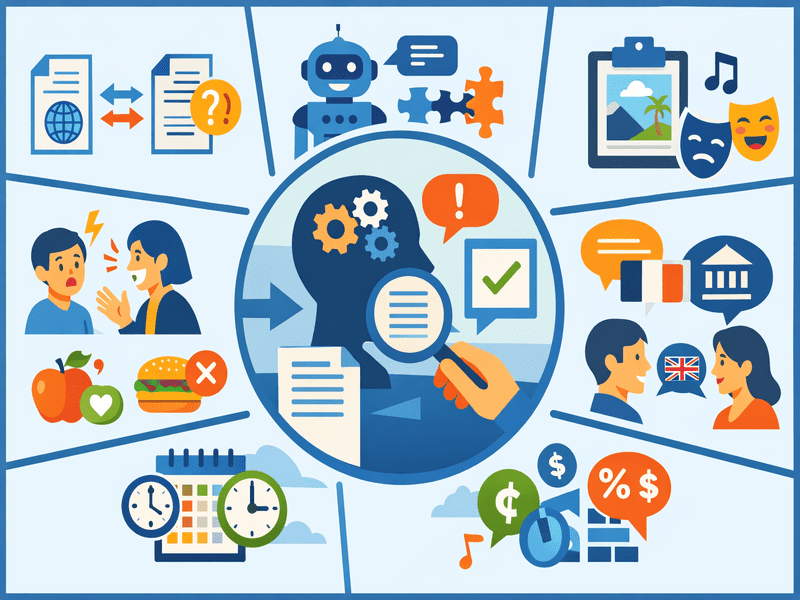
Although it is a useful tool, machine translation is not a translation service. It produces a draft.
Human linguists produce meaning, clarity, and trust.
- Fix MT errors
- Adapt content culturally
- Preserve formatting and design
- Ensure multilingual quality across platforms
Accuracy is essential in worldwide communication, and errors can be costly.
The most common machine translation errors: a summary
Using machine translation technologies hastily can lead to translation problems.
Use professional translators when your documents, slogans, product details, or web pages are extremely important. To cut costs and save time, they use translation memory and PEMT (post-editing machine translation), but they make sure that the texts are accurate and true to the originals. error-free and culturally appropriate.
So, if you want your texts in the hands of professionals, we recommend TextMaster’s translation services.
Conclusion
Machine translation is fast and useful, but it often fails to understand context, culture, and meaning. These mistakes can lead to confusion, embarrassment, or even brand damage. That’s why human linguists remain essential—to correct errors, adapt content culturally, and ensure every message is clear, accurate, and trustworthy across languages.
Super DTP Ltd is a specialized desktop publishing agency located in Gabrovo Bulgaria, offering book publishing, multilingual DTP, and E-learning localization services to translation agencies and localization companies worldwide! Check our services at www.superdtp.com or contact us at dtp.bulgaria@gmail.com for further details.